
What Is an RBT? A Complete Guide to Registered Behavior Technicians
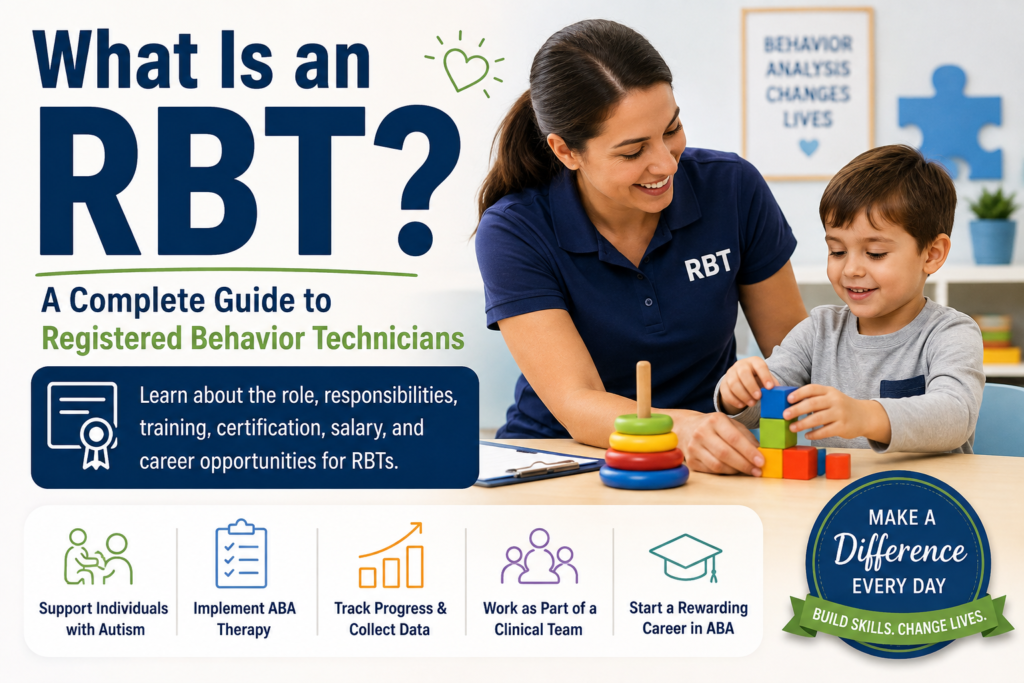
If you’re exploring ABA therapy or considering a career supporting people with autism, you may have wondered: What is an RBT? RBT stands for Registered Behavior Technician, a credentialed professional who provides behavior-analytic services under the supervision of qualified clinicians. RBTs often work directly with children with autism, helping them build communication, social, and daily living skills through structured support.
Their work can include ABA therapy, data collection, skill practice, and following individualized treatment plans. For families, an RBT can become an important part of a child’s care team. For job seekers, becoming an RBT can offer valuable experience and a practical starting point in behavior analysis.
What Is an RBT (Registered Behavior Technician)?
What is an RBT in simple terms? A Registered Behavior Technician is a paraprofessional who provides behavior-analytic services under supervision. RBT stands for Registered Behavior Technician, and the credential confirms that the technician has met specific certification standards.
An RBT doesn’t independently diagnose clients or create clinical treatment programs. Instead, RBTs work under the supervision of a BCBA or another qualified supervisor. Their work may involve direct therapy, skill practice, behavior support, documentation, and careful implementation of assigned procedures.
What Does an RBT Do?
So, what does an RBT do during a normal workday? The answer depends on the client and setting. An RBT may deliver one-on-one therapy, practice communication, teach adaptive skills, collect information, and follow an individualized treatment program.
A useful way to picture the role is to imagine a coach following a carefully designed training plan. The RBT role involves carrying out that plan consistently while watching how the client responds. The supervising clinician then uses objective information to guide clinical decisions.
What Are the Main Responsibilities of an RBT?
The core RBT responsibilities revolve around safe and consistent service delivery. Common RBT duties include implementing assigned programs, supporting learning, responding to behavioral challenges, documenting sessions, and communicating relevant observations to the supervising team.
Importantly, the technician must stay within their professional boundaries. RBT job responsibilities can look different across employers because client needs and service models vary. However, accurate implementation, respectful interaction, objective documentation, and professional conduct remain central.
Providing One-on-One ABA Therapy
During one-on-one ABA therapy, an RBT works directly with a client on specific goals. RBTs provide one-on-one ABA therapy by using approved procedures, prompts, practice opportunities, and reinforcement. Sessions may happen in clinics, homes, schools, or community settings.
Teaching Communication and Daily Living Skills
Communication and independence often become practical teaching targets. RBTs teach communication skills, RBTs teach social skills, and RBTs teach daily living skills through structured practice. Goals might include requesting help, following instructions, dressing, hygiene, or completing routines.
Implementing Behavior Intervention Plans
An RBT may follow a behavior intervention plan created under qualified clinical oversight. RBTs implement behavior intervention plans according to established procedures rather than inventing new strategies independently. This consistency helps the supervising clinician evaluate whether an intervention works as intended.
Collecting and Recording Client Data
Good ABA work depends heavily on objective information. RBTs collect data during therapy sessions using measurement systems selected for the program. Data collection might track frequency, duration, latency, percentage, or other measures that help the clinical team understand progress.
Where Do RBTs Work?
The RBT work environment can change considerably from one employer to another. RBTs commonly work in ABA clinics, homes, schools, community locations, and other approved service settings. Each environment creates different teaching opportunities and practical challenges.
A clinic may offer structured rooms and specialized equipment. A home session may focus on routines such as meals or hygiene. School-based work can involve classroom participation and social opportunities. The setting should always match the client’s treatment needs and authorized services.
| Work setting | Common focus | Typical feature |
|---|---|---|
| ABA clinic | Structured skill programs | Dedicated therapy spaces |
| Home | Daily routines | Natural family environment |
| School | Classroom and social skills | Educational routines |
| Community | Functional independence | Real-world practice |
Who Does an RBT Work With?
An RBT rarely works alone. RBTs work as part of a clinical team that may include a BCBA, BCaBA, caregivers, teachers, and other professionals. The exact team depends on the client, employer, treatment model, and service setting.
The technician may communicate with caregivers and parents about observations while respecting confidentiality and professional boundaries. Collaboration matters because skills often need practice beyond formal sessions. Consistent communication can strengthen family support and help teams notice meaningful changes.
What Is RBT Certification and Why Is It Important?
The RBT certification is a paraprofessional certification in behavior analysis. The BACB describes RBTs as practitioners who assist with behavior-analytic services under direction and close supervision. That credential creates a standardized professional pathway rather than relying only on an employer’s internal training.
The RBT certification process includes eligibility, training, competency evaluation, application, and examination requirements. Certification also comes with ongoing obligations. The BACB’s current handbook explains supervision, ethics, professional development, and recertification requirements.
What Are the Requirements to Become an RBT?
The current RBT requirements include being at least 18 years old and having a high school diploma or equivalent. Applicants must also satisfy background and abuse-registry screening requirements applicable under the current BACB rules.
The RBT eligibility requirements also include completing qualifying training and an initial competency assessment. The current RBT certification requirements changed for 2026, so older articles can contain outdated instructions. Always compare advice with the current RBT Handbook before applying.
| Requirement | Current purpose |
| Minimum age | Applicant must be at least 18 |
| Education | High school diploma or equivalent |
| Screening | Required background and applicable registry checks |
| Training | Current qualifying 40-hour program |
| Competency | Initial competency assessment |
| Application | Submit required documentation |
| Examination | Pass the RBT certification examination |
How to Become an RBT: Step-by-Step
If you’re wondering how to become an RBT, begin by checking your eligibility against the current BACB handbook. Next, complete qualifying training and arrange the required competency assessment. The assessment must follow the current rules and timing requirements.
After that, prepare your RBT application with the required documentation. Once approved, complete the examination process. The exact sequence and documents can change, which is why the BACB’s current handbook should remain your primary reference.
What Does RBT Training Include?
Quality RBT training teaches the practical foundations needed for entry-level behavior-analytic work. Training covers areas such as measurement, assessment, skill acquisition, behavior reduction, documentation, and ethics. The goal isn’t simply to memorize definitions; it’s to understand how those concepts affect real clients.
The current RBT training requirements specify a qualifying 40-hour program. The BACB says the training must meet its current curriculum requirements and take no fewer than five days or more than 180 days.
40-Hour RBT Training Course
The 40-hour RBT training course provides foundational instruction before certification. The current 40-hour RBT training must follow the BACB’s applicable curriculum requirements. Training may be offered through an employer, university, or online provider.
RBT Competency Assessment
The RBT competency assessment checks whether a candidate can demonstrate required practical skills. The current RBT initial competency assessment must be completed after qualifying training and within the applicable period before certification application.
RBT Certification Exam
The RBT exam tests knowledge across major areas of entry-level behavior technician practice. The current RBT certification exam uses the third-edition test content outline, which contains 75 scored questions and 10 unscored pilot questions.
The examination blueprint covers six domains: data collection and graphing, behavior assessment, behavior acquisition, behavior reduction, documentation and reporting, and ethics. Behavior acquisition carries the largest share at 25% of scored questions.
How Hard Is the RBT Exam?
Many candidates find the RBT exam manageable when they understand the concepts rather than memorize isolated terms. Questions can test how you would respond to realistic situations involving measurement, ethics, teaching procedures, documentation, and behavior reduction.
Preparation becomes easier when you study the current test outline first. Focus especially on terminology, examples, professional boundaries, and measurement. Because the examination content changed for 2026, old study materials may not perfectly match the current blueprint.
How Long Does It Take to Become an RBT?
The timeline depends on training availability, assessment scheduling, application processing, and examination scheduling. The current training requirement alone has a defined range: the 40-hour program must take at least five days and no more than 180 days.
That doesn’t mean every candidate will finish certification within the same number of weeks. A person with organized documentation and quick access to qualified professionals may move faster. Someone waiting for assessment or application processing may need additional time.
How Do RBTs Work With a BCBA?
The relationship between an RBT and a BCBA is central to quality behavior-analytic services. A Board Certified Behavior Analyst may develop, oversee, assess, and modify clinical programs while the RBT implements assigned procedures within their scope.
In simple terms, the BCBA designs treatment plans while the technician carries out applicable procedures and reports objective observations. BCBA supervises RBTs through structured oversight. Current BACB rules also require qualified RBT supervisors to complete an eight-hour supervision training before providing required supervision.
| Role | Primary focus |
| RBT | Implements assigned procedures and records observations |
| BCBA | Provides higher-level clinical direction and oversight |
| Caregiver | Supports relevant goals in daily life |
| Other professionals | Address needs within their professional discipline |
RBT vs. BCBA: What’s the Difference?
The RBT vs BCBA comparison becomes clearer when you look at education, certification, responsibilities, and clinical authority. An RBT is an entry-level paraprofessional credential. A BCBA is an advanced professional certification with substantially different educational and practice requirements.
The difference between RBT and BCBA isn’t simply a matter of job title. Their responsibilities differ by scope, training, and authority. An RBT supports implementation while a BCBA carries broader responsibility for clinical decision-making and supervision.
RBT vs. Behavior Technician: Are They the Same?
The RBT vs behavior technician question causes confusion because employers may use “Behavior Technician” as a job title. “RBT” refers specifically to the BACB credential. Therefore, someone can hold a Behavior Technician position without necessarily holding RBT certification.
In other words, behavior technician certification and RBT certification aren’t automatically interchangeable terms. Before accepting an RBT job, check the employer’s requirements carefully. Look at whether certification is required, expected after hiring, or simply preferred.
What Is an RBT’s Salary and Job Outlook?
RBT salary varies across the United States. Location, experience, employer, schedule, setting, demand, and benefits can all influence compensation. Hourly pay also matters because many RBT positions operate on hourly rather than salaried structures.
When comparing RBT salary and benefits, don’t focus on the hourly number alone. Examine paid training, health insurance, paid time off, supervision quality, scheduling, caseload expectations, and advancement opportunities. These details can significantly change the practical value of an offer.
| Compensation factor | Why it matters |
| Location | Local labor markets differ |
| Experience | Skills and tenure may influence pay |
| Schedule | Full-time and part-time structures differ |
| Benefits | Insurance and paid leave add value |
| Employer | Compensation models vary |
| Advancement | Growth can improve long-term earnings |
What Is a Typical Day in the Life of an RBT?
A typical day can begin with reviewing programs and preparing materials. During therapy sessions, the technician may teach skills, practice communication, follow behavior procedures, collect observations, and communicate relevant information to the supervising team.
The RBT daily responsibilities can shift quickly because every client has different needs. One session might emphasize communication. Another may focus on independence or reducing a specific behavioral challenge. That variety makes the work active, personal, and sometimes unpredictable.
Is Being an RBT a Good Career Choice?
For someone who enjoys helping people and learning practical behavior skills, an RBT career can be rewarding. The role offers direct client contact and can provide useful experience before pursuing additional education or career advancement in behavior analysis.
The RBT career path isn’t identical for everyone. Some technicians remain in direct-service roles. Others pursue trainer, supervisory, educational, or advanced clinical opportunities. Current certification maintenance also includes professional development for RBTs certified or recertified in 2026, with 12 professional development units required during each two-year cycle.
Frequently Asked Questions About RBTs
What does RBT stand for?
What does RBT stand for? It means Registered Behavior Technician. An RBT provides behavior-analytic services under appropriate supervision and follows assigned clinical procedures.
What is the difference between an RBT and a BCBA?
An RBT provides direct implementation within their role. A BCBA has broader clinical responsibilities and provides professional oversight. Their education, certification standards, and decision-making responsibilities differ.
Can you become an RBT without a college degree?
Yes. Current BACB eligibility rules require a high school diploma or equivalent rather than a college degree. Candidates must also meet the other certification requirements, including training and competency assessment.
How long does RBT certification take?
There isn’t one universal timeline. Training must meet specific duration rules, while assessment, application, and examination scheduling can affect the total process.
Is RBT certification difficult?
The process requires preparation, but many candidates can manage it with structured study and practical training. Understanding the current examination blueprint is especially useful for 2026 candidates.
Where can an RBT work?
RBTs may work in clinics, homes, schools, and community settings depending on their employer and authorized services. The RBT work environment can strongly influence daily activities.
How much does an RBT make?
Pay varies widely by location, employer, experience, schedule, and benefits. Compare the entire compensation package rather than relying on one hourly figure.
Can an RBT become a BCBA?
Yes, an RBT can later pursue BCBA certification if they meet the separate education, coursework, supervised fieldwork, examination, and other applicable requirements. RBT certification itself doesn’t automatically qualify someone as a BCBA.
Is an RBT the same as a behavior technician?
Not necessarily. A Behavior Technician can be a general employment title, while RBT identifies a specific BACB credential. Always review the employer’s stated requirements.
Final Thoughts
Understanding what is an RBT starts with one simple idea: an RBT is a trained paraprofessional who helps deliver behavior-analytic services under qualified supervision. The work combines direct client interaction, structured teaching, careful observation, documentation, and teamwork.
If you’re considering how to get RBT certification, start with the current BACB requirements rather than an older article or social-media checklist. The 2026 transition changed several important parts of the credential, including training, assessment, examination, and ongoing professional development.
The strongest next step is to read the current RBT Handbook and compare your situation with its eligibility and maintenance rules. The BACB provides the authoritative certification information, current forms, examination resources, and transition guidance.
Authoritative Sources
| Source | Purpose |
| Behavior Analyst Certification Board RBT page | Current certification resources and 2026 updates |
| RBT Handbook | Current eligibility, application, training, assessment, supervision, and maintenance requirements |
| RBT Test Content Outline, 3rd Edition | 2026 examination domains and question blueprint |
| BACB Supervision and Training | Current supervision and assessor/trainer requirements |
| RBT Professional Development | 2026 PDU requirements and professional development rules |