
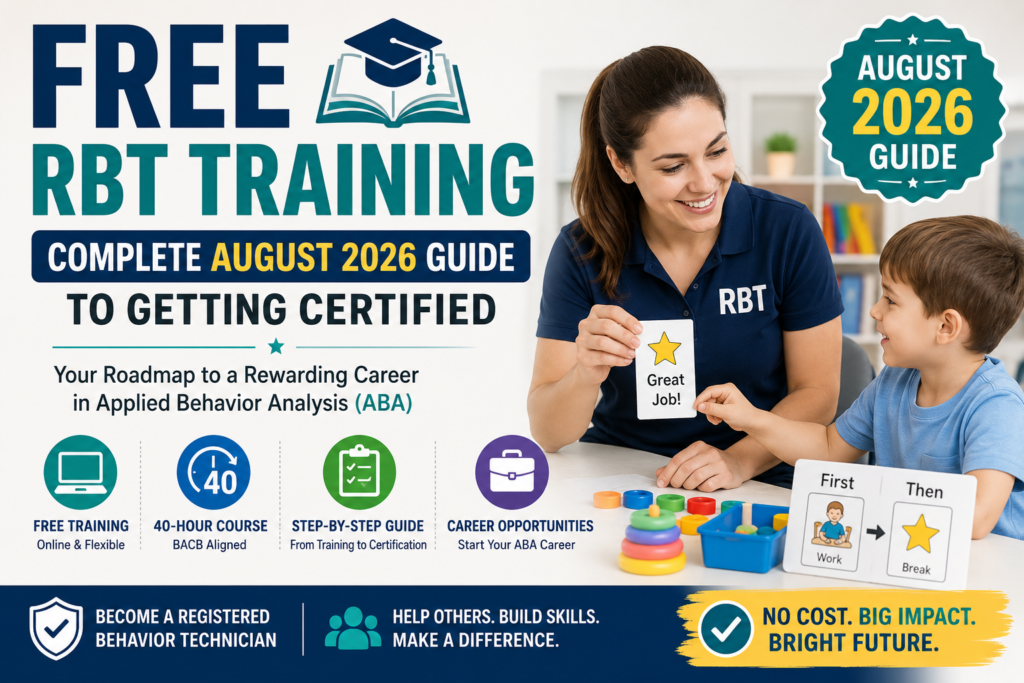
The Reality of Free RBT Training in Today’s Market
Free RBT training is a legitimate pathway into the applied behavior analysis field — but the word “free” carries important fine print that every aspiring Registered Behavior Technician needs to understand before enrolling.
The Registered Behavior Technician (RBT) credential is issued by the Behavior Analyst Certification Board (BACB) and serves as the entry-level certification for paraprofessionals delivering ABA therapy under the supervision of a Board Certified Behavior Analyst. Before any candidate can sit for the RBT exam, they must complete a 40-hour training program aligned with the BACB’s 2nd Edition Task List. That training covers measurement, skill acquisition, behavior reduction, documentation, and professional conduct. It is non-negotiable, and it is where most candidates encounter their first significant cost barrier — or discover that a no-cost option may exist.
Why free? Organizations such as the Autism Partnership Foundation offer free RBT training because expanding the pool of qualified technicians directly expands access to ABA services for families who need them. Workforce shortages drive this generosity as much as philanthropy does. When demand for qualified technicians outpaces supply, training costs become a recruitment barrier — and removing that barrier benefits everyone in the ecosystem.
Here is the distinction that trips up most applicants: completing a 40-hour training course earns you a training completion certificate, not the RBT credential itself. The BACB certification requires additional steps — a competency assessment, a background check, and passing the RBT exam — each of which may carry its own fees entirely separate from the training.
And the demand pressure making all of this urgent is real. RBT certificant numbers have grown substantially year over year, reflecting how rapidly ABA services are expanding across school, clinic, and home settings. That growth means the market for qualified technicians is strong — and knowing exactly where to find credible, no-cost training puts you ahead. The next section breaks down which providers actually deliver on that promise.
Top Providers for 40-Hour Online RBT Training at No Cost
The most credible no-cost RBT training programs share one defining trait: they are built directly around the BACB’s 2nd Edition Task List, which means the hours you log actually count toward certification.
Several reputable organizations have made their 40-hour training curricula freely accessible online, though each takes a different approach in terms of format, depth, and what you receive at the end.
Autism Partnership Foundation (APF) stands out as the most widely recommended starting point. The Autism Partnership Foundation free RBT training program, known as APF 40-Hour RBT Training 2.0, is a self-directed online learning format built on the 2nd Edition Task List. You move through the material at your own pace, which tends to work better for learners balancing other responsibilities. The content is developed by credentialed behavior analysts, giving it a level of professional legitimacy that sets it apart from generic online alternatives.
Blossom ABA offers another strong option, framing its 40-hour course as a therapy-led initiative designed to bring qualified technicians into the field faster. The program is structured to mirror real clinical environments, which often makes the transition from training to supervised fieldwork more manageable.
When evaluating any free provider, you should confirm the course meets a consistent set of criteria before committing your time:
- Explicitly covers all domains of the BACB 2nd Edition Task List
- Provides a completion certificate or documented proof of hours
- Is developed or reviewed by a credentialed BCBA
- Clearly states it satisfies the 40-hour training requirement
- Does not charge fees to access the core training content
What these programs do not cover, however, is the financial layer that begins the moment training ends. The BACB application process introduces its own set of fees that catch many applicants off guard — and that is exactly where the next step of this journey begins.
Navigating the BACB Requirements and Hidden Fees
Free RBT training covers the education component — but the Behavior Analyst Certification Board’s full certification pathway includes mandatory fees that every applicant must budget for before sitting for the exam.
Even the best RBT 40-hour training online free programs cannot absorb every cost in the pipeline. Once your training hours are logged, you enter a distinct certification process governed entirely by the BACB, and that process has line-item expenses attached to it.
The BACB application fee sits at $50, paid directly to the board when you submit your certification application. It is non-refundable, meaning an incomplete or rejected application does not entitle you to a reimbursement. Separately, the Pearson VUE exam fee runs $45, charged by the authorized testing center when you schedule your RBT examination. Together, those two fees alone represent a minimum out-of-pocket cost of $95 — even if your training was entirely free.
And those are not the only requirements. As the BACB mandates, applicants must complete a 40-hour training program, pass a competency assessment conducted by a qualified supervisor, and clear a background check before they are eligible to sit for the exam. The competency assessment itself may carry a cost depending on the supervising BCBA’s policies. Background check fees vary by provider and state but typically range from $20 to $50.
What this means in practice: a candidate who accesses entirely free training can still expect to spend $115 to $145 or more before earning the RBT credential.
The takeaway is straightforward — free training is the critical first step, but it is not the complete financial picture. Understanding the full cost structure upfront prevents the kind of mid-process sticker shock that derails otherwise qualified candidates.
The good news is that some employers cover these downstream costs entirely, which brings up an important question worth exploring: where exactly do you find those employers, and how does local versus online training factor into that decision?
Finding Free RBT Training Near You: Local vs. Online
The most practical path to RBT certification online for free often runs directly through an employer, not a training website — and knowing where to look can eliminate most of your out-of-pocket costs before you even apply.
ABA agencies across the country regularly absorb the cost of the 40-hour training as part of their hiring process. This “work-for-training” model is especially common in states with high demand for behavioral health staff, where agencies compete for entry-level candidates by offering paid onboarding that includes supervised instruction, competency check-offs, and even exam fee reimbursement. Many ABA agencies provide free training to new hires as part of their onboarding process, which means the certification can cost you nothing if you secure the right position first.
Searching job boards strategically is one of the most overlooked ways to access this model. Searching Indeed or LinkedIn for terms like “RBT Trainee,” “Behavior Technician Trainee,” or “ABA Therapist — No Experience Required” surfaces roles where training is built into the job itself. These postings often specify that the employer will cover both the 40-hour curriculum and the BACB application fee, making them a stronger starting point than hunting for standalone free courses.
Local versus online training each carry distinct trade-offs worth weighing carefully. In-person programs offered through regional ABA providers tend to include immediate supervised hours — which you need regardless — and hands-on competency practice with actual clients or role-play partners. Online self-paced modules offer scheduling flexibility, but they require you to arrange supervision separately, which adds coordination and potential cost. Neither format is universally better; the right choice depends on whether employer-sponsored access or scheduling control matters more to your situation.
Once you identify a program or employer-sponsored path, however, a separate obstacle tends to catch applicants off guard — the technical requirements of submitting your completed training documentation through the BACB’s certification portal.
Technical Hurdles: Mastering the Certification Portal Upload
Completing your RBT training is a significant achievement — but a surprising number of applicants hit a wall at the final step when their certificate file simply will not upload to the certification portal.
The obstacle is rarely the document itself. It is almost always the file size. Certification and government portals commonly enforce strict upload limits, and those limits can be tighter than most applicants expect. A typical range runs from 20KB on the lower end to 2MB on the upper end, and falling outside that window triggers an automatic rejection of the submission — no warning, no workaround offered.
High-resolution scans are the most frequent culprit. When you scan a certificate on a home printer or at a copy shop, the default settings often produce a crisp, detailed image file that looks professional. But that clarity comes at a cost: file sizes of 3MB, 5MB, or even larger are common outputs. These files exceed portal maximums and cannot be submitted as-is. And because the BACB requires specific documentation — including your 40-hour training certificate and competency assessment results — there is no flexibility around which documents must be submitted. You need the right file, at the right size, with the content still legible.
Precision compression is the practical solution to this gap. Unlike generic image resizing, precision compression reduces a file’s data footprint while preserving enough visual clarity for official review. The goal is not simply to make the file smaller — it is to hit a specific target size without degrading the document to the point where a reviewer cannot read your name, training dates, or issuing organization.
This is a technical step that many applicants underestimate until their first submission bounces. Understanding which file formats — JPEG, PNG, or WebP — behave differently under compression is equally important, and choosing the right tool for the job can save significant time during what is already a multi-step process.
How to Compress Your RBT Certificate for Official Portals
Uploading your RBT training certificate to an official portal is often blocked by a strict 20KB file size limit — and knowing exactly how to hit that target without sacrificing legibility can save you hours of frustration.
Once your training is complete and your certificate is in hand, the next practical obstacle is technical: most BACB-affiliated portals enforce tight upload constraints. A standard certificate scan or screenshot will almost always exceed the limit. The solution is a purpose-built compression tool that processes your file directly in the browser, keeping sensitive personal information off third-party servers.
Client-Side Processing and Document Privacy
Pro Tip: Tools that use client-side processing — meaning all compression happens inside your browser rather than on a remote server — are the safest choice for official documents. Your certificate contains personal identifiers, license numbers, and training dates. With client-side tools, the file never leaves your device, which eliminates upload-based privacy exposure entirely.
Step-by-Step: Compressing Your Certificate to 20KB
Follow these steps to compress your certificate while keeping every line of text readable:
- Open the tool — Navigate to CompressImageTo20KB.in in any modern browser. No account or download is required.
- Upload your file — Click the upload area and select your certificate. The tool accepts JPEG, PNG, and WebP formats, which covers virtually every export option from scanners, phones, and PDF converters.
- Set your target — Confirm the target is set to 20KB. Some portals accept up to 50KB; adjust accordingly if the portal documentation specifies a different ceiling.
- Preview before downloading — Use the side-by-side preview to verify that your name, training provider, completion date, and any certification numbers remain sharp and fully legible. If text looks blurry, reduce compression slightly.
- Download the compressed file — Save the output with a clear filename such as
RBT_Certificate_Compressed.jpgso it is easy to locate during the portal upload session. - Confirm the file size — Right-click the downloaded file and check properties to verify it falls at or below the portal limit before you begin the official submission.
Format Considerations
JPEG tends to work better for scanned documents with color gradients, while PNG is often more effective for certificates generated digitally with sharp text and solid backgrounds. WebP is an acceptable fallback if your device exports in that format by default, though some older portal systems may not accept it — always check the portal’s accepted file type list before compressing.
Getting this step right protects both your timeline and your privacy. But technical file preparation is only one piece of the puzzle — the quality and legitimacy of the free program you trained through matters just as much, and that is where applicants most commonly make costly mistakes.
Common Pitfalls in Free RBT Programs and How to Avoid Them
Not every free RBT training program is worth your time — and choosing the wrong one can invalidate months of work before your application ever reaches a reviewer.
The previous sections walked through the mechanics of uploading and compressing your certification documents. But none of that matters if the underlying training itself does not meet BACB standards. Understanding where free programs tend to fall short is the most effective way to protect your investment of time and energy.
- Diploma mills masquerading as accredited providers. A common pattern is for low-credibility online platforms to advertise “BACB-approved” training without holding any formal recognition. The BACB does not directly accredit training programs; instead, it requires that training be conducted by a qualified BACB certificant to be valid for the RBT application. Before enrolling, verify that a named BCBA or BCaBA is directly overseeing the curriculum — not simply listed in fine print.
- Outdated 1st Edition Task List materials. Some free platforms have never updated their content to reflect the current 2nd Edition RBT Task List. Completing 40 hours on superseded material means you will study concepts that no longer align with the exam blueprint, creating a real risk of failure even after finishing the course.
- Technical glitches in free LMS platforms. Free learning management systems tend to have less reliable infrastructure than paid alternatives. Progress tracking can fail silently, leaving you without documentation of completed modules. One practical approach is to take dated screenshots after each module completion and store them in a dedicated folder as a personal backup.
- Unqualified supervisors conducting the Competency Assessment. Your supervisor must hold active BCBA or BCaBA certification at the time of the assessment — not just at the time of hire. Confirm their certification status directly through the BACB certificant registry before scheduling this critical evaluation.
Avoiding these pitfalls ultimately comes down to verification at every stage of the process. With those risks clearly mapped out, the next step is pulling everything together into a practical action plan you can follow from enrollment to exam day.
The Bottom Line: Your Checklist for Free RBT Success
Free RBT training is a genuine opportunity — but only when you approach it with the same administrative precision you would bring to the clinical work itself.
As one industry expert puts it, “Success in the RBT application process is as much about administrative precision as it is about clinical knowledge.” The sections above have walked through the most common traps: unverified providers, hidden fees, and document upload failures. What follows distills everything into four non-negotiable checkpoints that separate successful applicants from those who lose weeks to preventable errors.
Provider verification is the foundation of the entire process. Start by confirming that your chosen program aligns with the BACB’s task list requirements before you complete a single module. The Autism Partnership Foundation’s free RBT training is one of the most widely recognized no-cost options that meets this standard, and starting there tends to work better than auditing a lesser-known program after the fact.
Fee planning comes next. Free training covers your 40 hours — not the $45 BACB application fee or the $45 RBT exam fee. Budget a firm $95 from the outset so that cost never stalls your momentum at the finish line. And on the other hand, do not let that relatively modest figure catch you off guard; the full RBT application process has several sequential steps, each with its own deadline.
BCBA alignment is where many candidates underestimate the timeline. Securing a supervising BCBA for your competency assessment is not a last-minute task. In practice, qualified supervisors book weeks or months in advance, so initiating that relationship during — not after — your 40-hour training is far more effective.
Document readiness closes the loop. Portal upload limits, particularly that strict 20KB ceiling for certificate files, will reject non-optimized PDFs without explanation. Applying the compression steps covered earlier ensures your paperwork clears technical review on the first attempt.
With these four checkpoints in place, you are fully positioned to move into the final phase — turning your completed training into a verified credential and launching your ABA career.
Next Steps After Completing Your 40-Hour Training
Completing your 40-hour RBT training is a milestone, but the path to employment and long-term certification success depends on what you do in the weeks immediately after.
Listing your training on a resume requires more than a single line item. ABA employers respond well to specificity — note the provider name, the training format (self-paced online or supervisor-led), and the fact that it meets BACB’s 40-hour training requirement. If your program included competency-based assessments or practice scenarios, mention those too. That level of detail signals that you understand the field’s standards before you walk through the door.
Exam preparation tends to work better when you combine structured review with timed practice. Free practice tests are widely available through ABA-focused organizations and community forums, and using them under realistic conditions — timed, distraction-free — gives you an accurate picture of where to focus your remaining study hours. The RBT Task List, published directly by BACB, is the authoritative framework every question maps to, so align your review to it rather than relying solely on third-party summaries.
Certification maintenance is an ongoing commitment that many new RBTs underestimate. RBT certification must be renewed annually, and each renewal cycle requires a new competency assessment along with a renewal fee. Planning for those checkpoints from day one — setting calendar reminders, budgeting for fees, and maintaining a strong relationship with your supervisor — prevents the kind of lapsed certification that can interrupt your career at the worst possible moment.
The opportunity in front of you is real. Free, BACB-compliant training has removed the primary financial barrier that once kept qualified candidates out of the ABA workforce. And what separates successful applicants from those who stall is almost always execution — the discipline to verify credentials, organize documentation, and submit a polished application package. Start today, compress your application materials with the right tools, and take the first concrete step toward a career that makes a measurable difference.
Frequently Asked Questions About Free RBT Training
Is RBT training free?
Sometimes. Some employers, nonprofits, and organizations provide training without charging tuition. However, other certification-related expenses may still apply. Always confirm exactly what the program covers before enrolling.
Are there free RBT training programs?
Yes. Candidates may find free programs through foundations, employers, community organizations, and other providers. Availability changes, so verify the current program details before beginning.
What are the RBT training requirements?
The initial training requirement is an important part of the certification pathway. Candidates should follow the current BACB requirements and confirm that their selected course satisfies the applicable standards.
Is the 40-hour RBT training free?
Some programs offer the required training at no tuition cost. Others charge a fee. Employer-sponsored programs can also eliminate or reduce direct training expenses.
Where can I get free 40-hour RBT training?
Look at reputable training organizations, ABA employers, nonprofit programs, and established foundations. Verify the course against current requirements before counting it toward your certification pathway.
How long does RBT training take?
The required initial training involves at least 40 hours. The calendar time needed to finish depends on the provider’s schedule and your available study time.
What does the RBT 40-hour course cover?
It covers core RBT knowledge and skills connected with measurement, assessment, skill acquisition, behavior reduction, documentation, reporting, and professional conduct.
Is free online RBT training legitimate?
It can be, but the word “free” doesn’t establish legitimacy. Check the provider, curriculum, completion documentation, and current BACB requirements before enrolling.
Can I work while completing RBT training?
Often, yes. Online and self-paced formats can make this easier. Employer-sponsored programs may also combine training with paid employment.
What jobs can I get after RBT training?
Training can prepare you for behavior technician opportunities in ABA providers and related settings. Actual employment depends on certification, employer requirements, location, and available positions.
Final Thoughts on Free RBT Training
Choosing free RBT training can reduce one of the biggest barriers for people entering ABA. Still, your goal shouldn’t simply be to find a course that costs nothing. Your goal should be to find a credible pathway that prepares you for training, competency evaluation, application, examination, and professional practice.
Whether you choose online coursework, an employer-sponsored program, or another affordable route, verify every requirement before committing. With careful planning, practical preparation, and the right supervision, you can move from training toward RBT certification with much greater confidence.