
Step 1: Complete the 40-Hour RBT Training
Before you can sit for the RBT competency assessment, you need to clear one non-negotiable prerequisite: a structured 40-hour training program built on the RBT Task List (2nd Edition). Think of this training as the foundation everything else rests on. Without it verified and documented, your application simply cannot move forward.
Here is what you need to confirm and gather before proceeding:
- Task List alignment: Verify that your training program explicitly covers the RBT Task List (2nd Edition) published by the BACB. Any program that references an older edition or a non-BACB framework will not satisfy the requirement.
- 180-day validity window: Per the BACB RBT Handbook, the 40-hour training must be completed within 180 days of the date your RBT application is submitted. Complete your training too early, and the clock will run out before you finish the rest of the process.
- Certificate of completion: Obtain a written or digital certificate from your training provider. This is your first primary document and will be required for the BACB portal upload when you submit your application materials.
- Qualified trainer confirmation: Confirm that the individual who delivered or supervised your training holds active BCBA or BCaBA certification. The BACB requires a Board Certified Behavior Analyst or Board Certified Assistant Behavior Analyst to oversee and sign off on this portion of your requirements.
⚠ Important: The 180-day window is a hard deadline, not a soft guideline. If your training completion date falls outside that window relative to your application date, you will need to retake qualifying training before submitting. Plan your timeline carefully and work backward from your target application date to avoid losing progress.
Once your training is verified, your certificate is in hand, and your trainer credentials are confirmed, you are ready to identify the right assessor and schedule your evaluation — which is exactly where the next step picks up.
Step 2: Find a Qualified Assessor and Schedule the Evaluation
With your 40-hour training complete, the next priority is securing a qualified assessor and understanding exactly what the evaluation involves. Knowing how to pass the RBT competency assessment starts here — with the right person, the right format, and a clear picture of what you will be asked to demonstrate.
Follow these steps to lock in your assessor and set yourself up for a structured, confident evaluation.
- Identify a BCBA or BCaBA to serve as your assessor. The BACB requires that the competency assessment be conducted by a Board Certified Behavior Analyst (BCBA) or a Board Certified Assistant Behavior Analyst (BCaBA). In practice, your employer or ABA agency will often assign this person, typically your direct supervisor. If you are pursuing certification independently, reach out to a supervising BCBA in your area or through a credentialed training organization.
- Choose between a “With a Client” or “Role-Play” format. You and your assessor will select which demonstration format fits your current situation. The “With a Client” format involves working with an actual client during a live session. Role-play uses a stand-in to simulate client interactions. Both are fully valid, and your assessor will guide which option is most appropriate given your access to clients and your setting.
- Download and review the RBT Initial Competency Assessment packet. The packet outlines all 20 specific tasks across skill areas including Measurement, Skill Acquisition, Behavior Reduction, Documentation, and Professional Conduct. Reviewing this document in advance removes guesswork and ensures you are preparing against the exact criteria your assessor will use.
- Understand the three assessment methods your evaluator will use. The evaluation is not a single event — it combines three distinct formats:
- Interview: Your assessor asks direct questions to gauge conceptual understanding of ABA principles and task-specific knowledge.
- Role-Play: You demonstrate targeted skills with your assessor or a volunteer acting as the client.
- Observation: Your assessor watches you apply skills in a real or simulated session.
- Confirm the session logistics with your assessor. [The assessment can be conducted over one or more sessions, in person or via live video](http://www.bacb.com/rbt-handbook), which offers meaningful scheduling flexibility. Clarify with your assessor how many sessions are planned, what technology or location is required, and what documentation you need to bring.
- Schedule the evaluation with adequate preparation time built in. Avoid booking the assessment immediately after your training ends. Allow yourself at least one to two weeks to review the task list, practice role-play scenarios, and ask your supervisor targeted questions about any skill areas that feel less solid.
Once you have a confirmed date and a clear understanding of the format, the focus shifts entirely to performance — demonstrating the clinical skills your assessor needs to see across every task category.
Step 3: Demonstrate Clinical Skills and Pass the Assessment
With your assessor scheduled, the Registered Behavior Technician competency assessment shifts from paperwork to performance. This is the live demonstration phase — where you show, not just tell, that you can apply ABA principles with a real or role-play client. The 2024 first-time pass rate for the RBT certification exam sits at 73%, but mastery begins here, at the competency level. Approach each task area deliberately.
Here is how to move through the demonstration with confidence and precision.
- Master the Measurement tasks first. Measurement is one of the most heavily weighted sections and the area where candidates most commonly stumble. Practice both continuous recording methods — such as frequency, duration, and latency — and discontinuous methods like partial and whole interval recording. During the live session, your assessor will expect you to collect data accurately and in real time, so rehearse until the process feels automatic.
- Demonstrate Skill Acquisition techniques clearly. Show your assessor that you can implement prompting hierarchies (from most-to-least and least-to-most), apply prompt fading systematically, and deliver reinforcement contingently and immediately. Each of these procedures must be executed as written in the behavior intervention plan — improvisation signals a lack of procedural fidelity.
- Execute Behavior Reduction strategies with precision. When demonstrating extinction, maintain consistency even when the behavior intensifies briefly. Show differential reinforcement by withholding reinforcement for the target behavior while simultaneously reinforcing an appropriate alternative. Reviewers look for composure and technical accuracy together.
- Maintain professional conduct and ethical standards throughout. Follow every guideline outlined in the [BACB’s RBT ethics code](https://www.bacb.com/rbt/) without deviation. Maintain appropriate boundaries with the client, protect confidentiality, and defer clinical decisions to your supervisor. Ethical lapses during the assessment — even minor ones — are grounds for an automatic fail.
- Request immediate feedback after each task cluster. In practice, many assessors will note errors without stopping the session. After each major section wraps, ask your assessor directly whether you need to retry any item. Addressing a gap in the moment is far more efficient than discovering it at the end.
Once every task is marked as passed, your assessor signs off on the completed packet. And that signed document becomes the critical artifact you will need for the next step — preparing and submitting your files to the certification portal without errors or upload rejections.
Step 4: Prepare and Optimize Your Documents for Portal Upload
After passing your assessment, the momentum should carry directly into document preparation. The RBT initial competency assessment packet must be uploaded through your BACB account before you can advance to the examination phase — and a surprisingly common source of delay is not the assessment itself, but the file that represents it. Following a precise preparation process protects your timeline.
- Obtain the signed packet from your assessor. Collect the fully completed competency assessment packet immediately after your session. Confirm that every required section carries both your signature and your assessor’s signature. Missing or partial signatures are the most frequent reason the BACB flags a submission for correction.
- Scan or photograph each page with care. Place the document on a flat, well-lit surface. Capture every page at a resolution high enough to make handwriting and signatures clearly legible. Blurry or shadowed images create ambiguity that reviewers may reject outright.
- Check the portal’s file size requirements before you upload anything. Certification portals commonly enforce strict limits — often between 20KB and 500KB. What looks like a simple scan on your phone can easily generate a file several megabytes in size, which the portal will silently reject or return an error for.
- Compress the file without sacrificing legibility. Use a precision compression tool to reduce the file to a size the portal will accept while keeping all text and signatures readable. Tools like CompressImageTo20KB.in allow you to target a specific output size, which tends to work better than generic compression that may overshoot or undershoot the limit.
- Rename the file clearly before uploading. A descriptive filename — such as “LastName_RBT_Competency_Assessment” — makes it easier for reviewers to locate and process your document and helps you track versions if a resubmission is ever needed.
- Store a secure personal copy before submitting. Save an optimized digital copy in a private, password-protected location. You are responsible for your own records, and [BACB application portals](https://www.bacb.com/tag/application/) do not guarantee ongoing access to documents you have already submitted.
Privacy note: Your competency assessment contains identifying information about both you and your clients. Handle physical and digital copies accordingly — store them in encrypted folders and avoid sharing them through unsecured channels such as standard email.
Getting your documents submission-ready is the last hands-on task before the finish line. Understanding what separates a clean first submission from a frustrating resubmission cycle is exactly the kind of insight the next section brings together.
Step 5: Finalize the BACB Portal Upload and Plan for Renewal
Once your documents are optimized, the final stage is the BACB portal upload. Passing the live evaluation is a significant milestone, but your certification isn’t official until the Board processes your application. Understanding how to pass RBT competency assessment requirements isn’t just about the clinical skills—it’s about the administrative follow-through.
- Log in to your BACB account. Navigate to the “Applications” section and select the RBT Initial Application.
- Upload your optimized files. Attach your 40-hour training certificate and your signed RBT initial competency assessment packet. Using a precision compression tool ensures you meet the strict file size limits without losing signature legibility.
- Pay the application fee. Your submission won’t be reviewed until the fee is processed. Keep the receipt for your records or employer reimbursement.
- Wait for the email to schedule your exam. The BACB typically reviews applications within two weeks. Once approved, you’ll receive a Pearson VUE authorization email to schedule the final written exam.
- Set a reminder for your annual renewal. Your certification isn’t permanent. An RBT competency assessment renewal must be completed every year, involving a new assessment conducted within 45 days of your certification anniversary.
Result: Your application is submitted, and you are officially cleared to schedule the RBT examination.
Final Takeaways for Success
- The 90-Day Rule: The registered behavior technician competency assessment is only valid for 90 days from the date the assessor signs it. Per the BACB RBT Handbook, if you don’t complete the portal upload within this window, the assessment expires, and you must undergo a full reassessment.
- Document Integrity: Always keep digital backups. Whether it’s for your initial application or your future RBT competency assessment renewal, having a clear paper trail is essential for maintaining your professional standing.
How to Ensure Your RBT Success: Key Takeaways
Completing the RBT competency assessment is a significant milestone, but the steps you take immediately after passing are just as important as the preparation that came before. From submitting your application on time to keeping your records organized, the details you manage in the final stretch will determine how smoothly your certification lands — and how well you are positioned for RBT competency assessment renewal down the road.
Follow these steps to protect your progress and close out the process correctly:
- Submit your application immediately after passing. The assessment is valid for only 90 days, and that window closes faster than most candidates expect. Delays in document preparation or portal upload can push you past the deadline, forcing a full reassessment. Treat the approval as your starting gun, not a rest period.
- Approach every practice session as a mock exam. The retake pass rate drops to just 36%, which means first-time success is not just preferable — it is strategically critical. Candidates who simulate real assessment conditions during preparation consistently perform better than those who treat practice as informal review.
- Audit your documents before uploading. Technical errors in document uploads remain a leading cause of application delays. Verify file formats, check that all signatures are visible, and confirm file sizes fall within portal limits before you submit anything.
- Save a digital, optimized copy of your signed assessment. Store it in a clearly labeled folder with your other certification records. This copy will matter when renewal cycles begin, and auditors or supervisors request verification of your completed packet.
The path from passed assessment to active certification is shorter than it seems when you stay organized and move with purpose. Every step above removes a common point of failure — and completing them puts you ahead of the candidates who stumble at the finish line.
Frequently Asked Questions About the RBT Competency Assessment
When can I take my RBT competency assessment?
The initial assessment follows completion of the required 40-hour RBT training. It occurs before the examination stage described in the supplied source.
How long is the RBT competency assessment?
There is no single fixed duration. The assessment can vary according to demonstrations, role-play, interviews, workplace arrangements, and whether the assessor divides the tasks across sessions.
Who administers the RBT competency assessment?
A qualified assessor conducts the evaluation. The assessment involves observation and documentation of your performance against the required competencies.
Where is the RBT competency assessment completed?
The setting can vary. Assessment methods may involve an actual client session, role-play, or interview. The appropriate setting depends on the task and applicable requirements.
Can I take the RBT competency assessment online?
An online RBT assessment may be possible depending on the applicable assessment method and organizational arrangements. However, don’t assume every task can automatically be completed online. Confirm the current requirements with your assessor.
Can I schedule the RBT competency assessment on weekends?
Weekend scheduling depends on the provider and assessor. There isn’t a universal rule guaranteeing weekend appointments. Ask your assessment provider about available times.
What are the RBT competency assessment competencies?
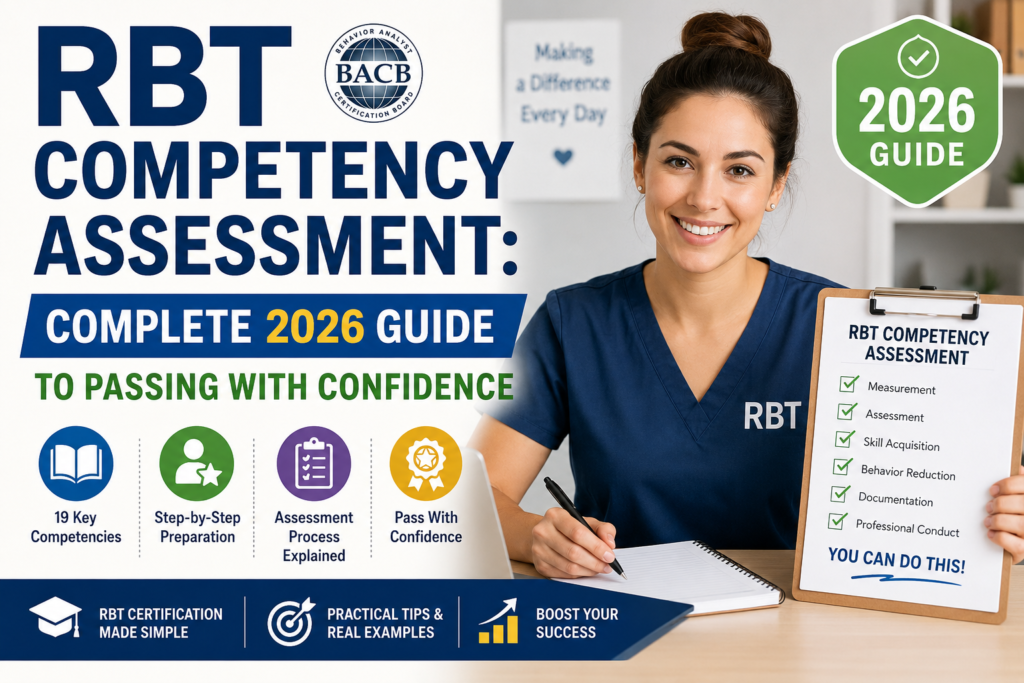
The 19 RBT competencies in the 2026 initial assessment cover practical areas such as measurement, assessment, skill acquisition, behavior reduction, documentation, and professional conduct.
What happens if I fail the RBT competency assessment?
Your assessor can identify the skills that need improvement and explain the applicable reassessment process. Policies may vary by organization.
Can I retake the RBT competency assessment?
Yes, reassessment can be possible when a candidate doesn’t demonstrate competency. However, the exact RBT competency assessment retake process depends on applicable rules and your provider’s procedures.
How do I pass the RBT competency assessment?
The strongest approach is practical preparation. Review the current task list, practice each skill, use realistic scenarios, record data carefully, and ask for supervisor feedback before assessment day.
Is the RBT competency assessment the same as the RBT exam?
No. The competency assessment evaluates practical performance. The RBT exam is a separate certification examination. The supplied source places the initial competency assessment before the exam stage.
What should I study for the RBT competency assessment?
Focus on the current task list rather than random study materials. Practice measurement, assessment procedures, teaching skills, behavior reduction, documentation, and professional conduct. Your RBT competency assessment study materials should support hands-on practice rather than memorization alone.